
POWERZ
ORIGINAL DESIGN PROPOSAL
GAME & LEVEL DESIGNER
Turn learning into adventure.
Developed an original Game & Level Design concept for POWERZ as part of a recruitment design test, combining two educational objectives: teaching children the fundamentals of programming and introducing them to Greek mythology.
01
CONCEPT &
DESIGN PILLARS
As part of a recruitment design test for POWERZ, I was challenged to create an original gameplay and level design proposal around two educational objectives: teaching children the fundamentals of programming and introducing them to Greek mythology.
I developed a concept in which programming becomes the player’s primary means of interacting with the world. Through a visual scripting system, players investigate corrupted mythological events, experiment with sequences of commands and restore legendary stories.
My proposal covered the core gameplay mechanics, world structure, level progression, narrative framework and puzzle-driven boss encounters, documented in a comprehensive Game Design Document.
LEARN
Turn knowledge into discovery.
Transform educational objectives into meaningful gameplay experiences. Rather than teaching programming and Greek mythology through traditional lessons, the concept encourages players to acquire knowledge by exploring legendary environments, interacting with mythological characters and uncovering forgotten stories. Each discovery provides new information or tools that help players understand the world and progress through their adventure.
EXPERIMENT
Make logic tangible.
Place experimentation at the heart of the gameplay loop through an accessible visual scripting system. Players combine programming blocks to define actions, control characters and manipulate their environment. By executing sequences, observing the results and correcting mistakes, they progressively develop their understanding of programming logic. Challenges encourage curiosity, problem-solving and iteration, turning trial and error into a rewarding learning process.
RESTORE
Give learning a purpose.
Connect every learning experience to a meaningful objective within the adventure. As Amnesium corrupts the world of Greek mythology, players must investigate anomalies, recover missing knowledge and use their programming skills to repair legendary events. From environmental puzzles to encounters with mythological creatures, each challenge reinforces the connection between knowledge and action. Progressively restoring the world gives players a tangible sense of achievement while driving the narrative forward.
02
WORLD &
LEVEL DESIGN
The adventure unfolds across three interconnected regions inspired by Greek mythology, combining exploration, legendary encounters and visual scripting challenges.
By recovering forgotten knowledge and repairing corrupted myths, players unlock new areas and progress toward Mount Olympus, turning learning into a meaningful part of their journey.
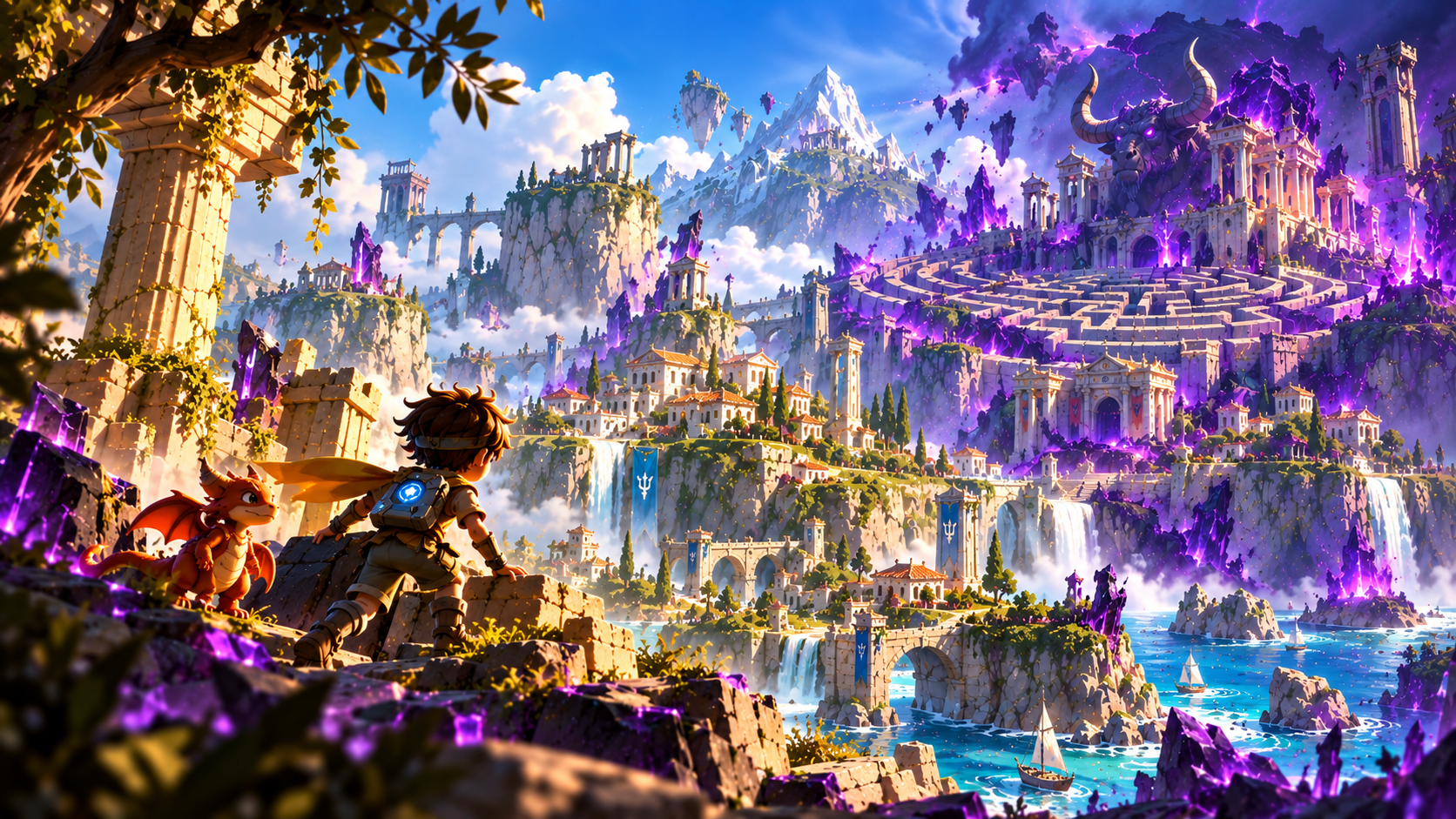
LANDS
GREECE · CRETE · MOUNT CAUCASUS
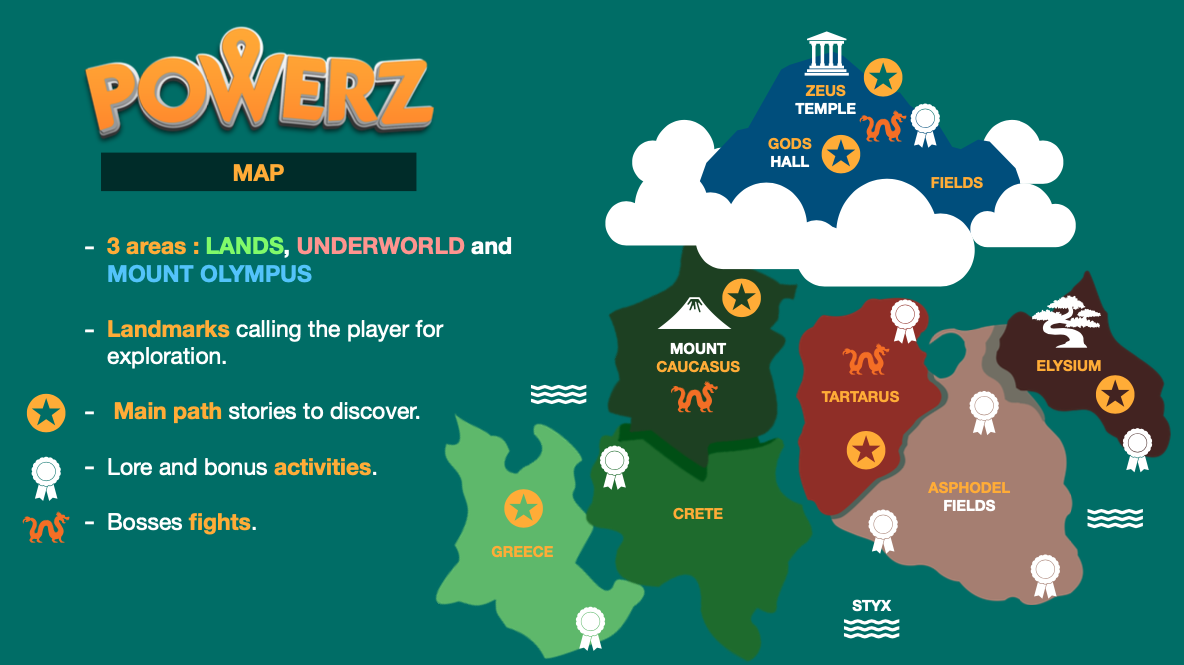
The Lands introduce players to a vibrant mythological world inspired by ancient Greece. Across three distinct locations, players explore legendary environments, uncover corrupted stories and use visual scripting to restore key events.
Exploration and environmental challenges gradually prepare players for their confrontation with the Amnesium-Minotaur, a puzzle-driven encounter that tests their understanding of the mechanics.
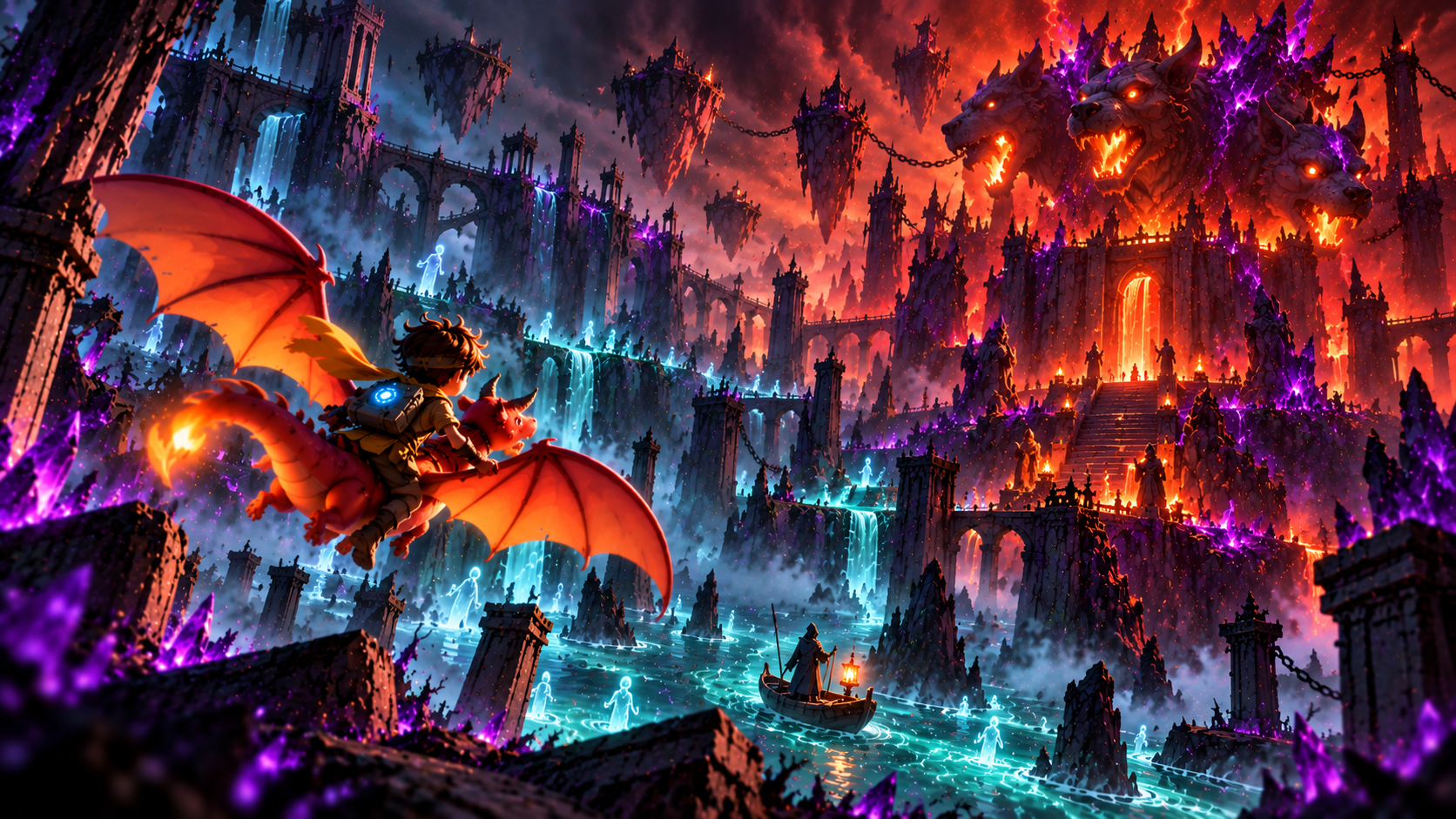
UNDERWORLD
ASPHODEL FIELDS · TARTARUS · ELYSIUM
The Underworld offers a contrasting journey through three iconic realms of Greek mythology. From the Asphodel Fields to Tartarus and Elysium, each location expands the adventure through new mythological discoveries and environmental challenges.
Players must investigate corrupted events and apply their programming skills to overcome obstacles, culminating in an encounter with Amnesium-Cerberus that combines observation, timing and problem-solving.
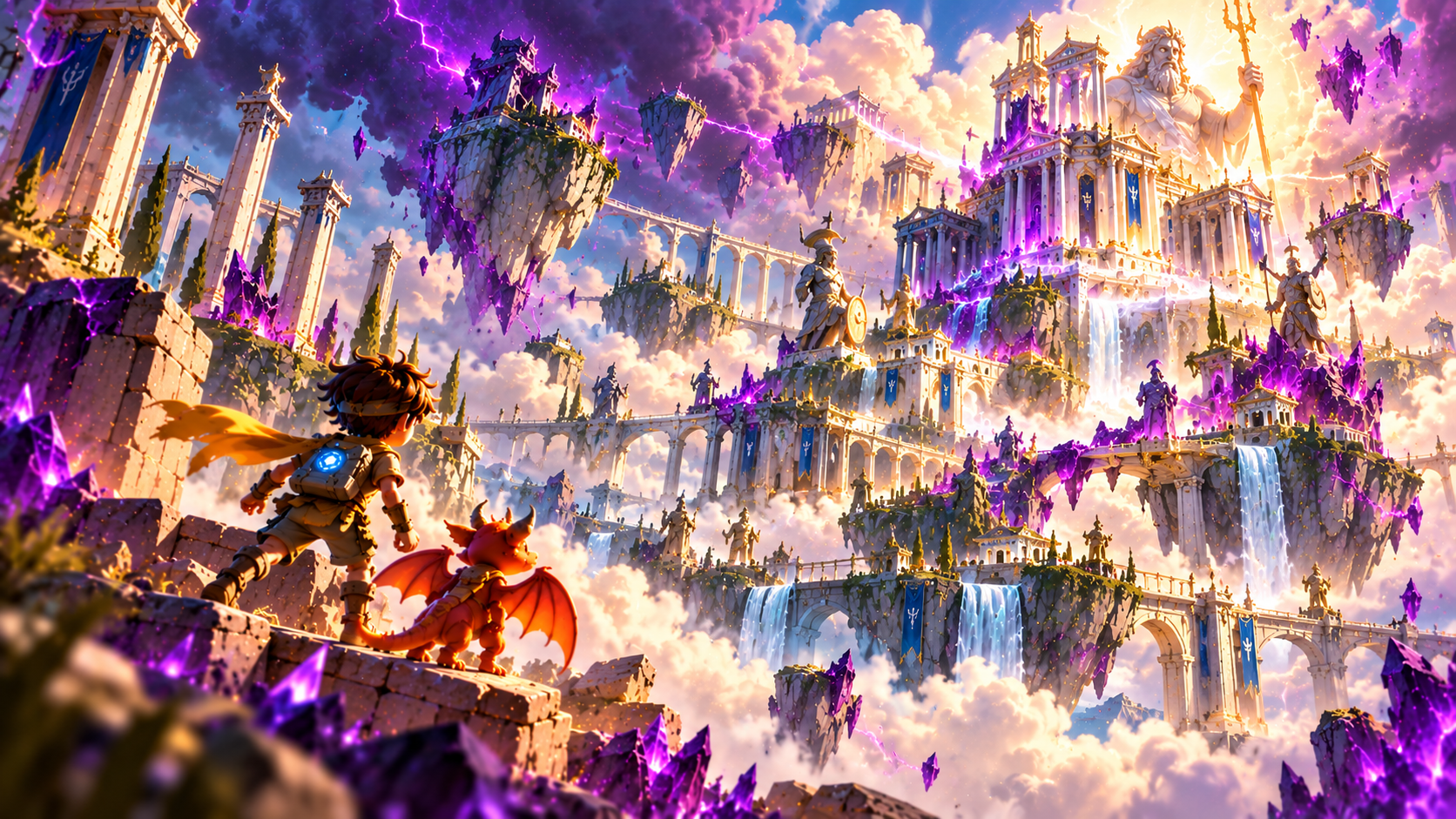
MOUNT OLYMPUS
FIELDS · GODS HALL · ZEUS TEMPLE
Mount Olympus serves as the final destination of the adventure, becoming accessible once players have progressed through both the Lands and the Underworld.
Across its three locations, players confront the consequences of Amnesium’s corruption on the realm of the gods. The journey culminates in a final puzzle-driven confrontation with Cronos, bringing together the knowledge and programming skills acquired throughout the adventure.
03
GAMEPLAY FEATURES
At the heart of the concept lies an accessible visual scripting system that allows players to interact with the mythological world through programming.
By combining commands, experimenting with sequences and correcting corrupted events, players gradually develop their understanding of coding logic while progressing through an adventure inspired by Greek mythology.
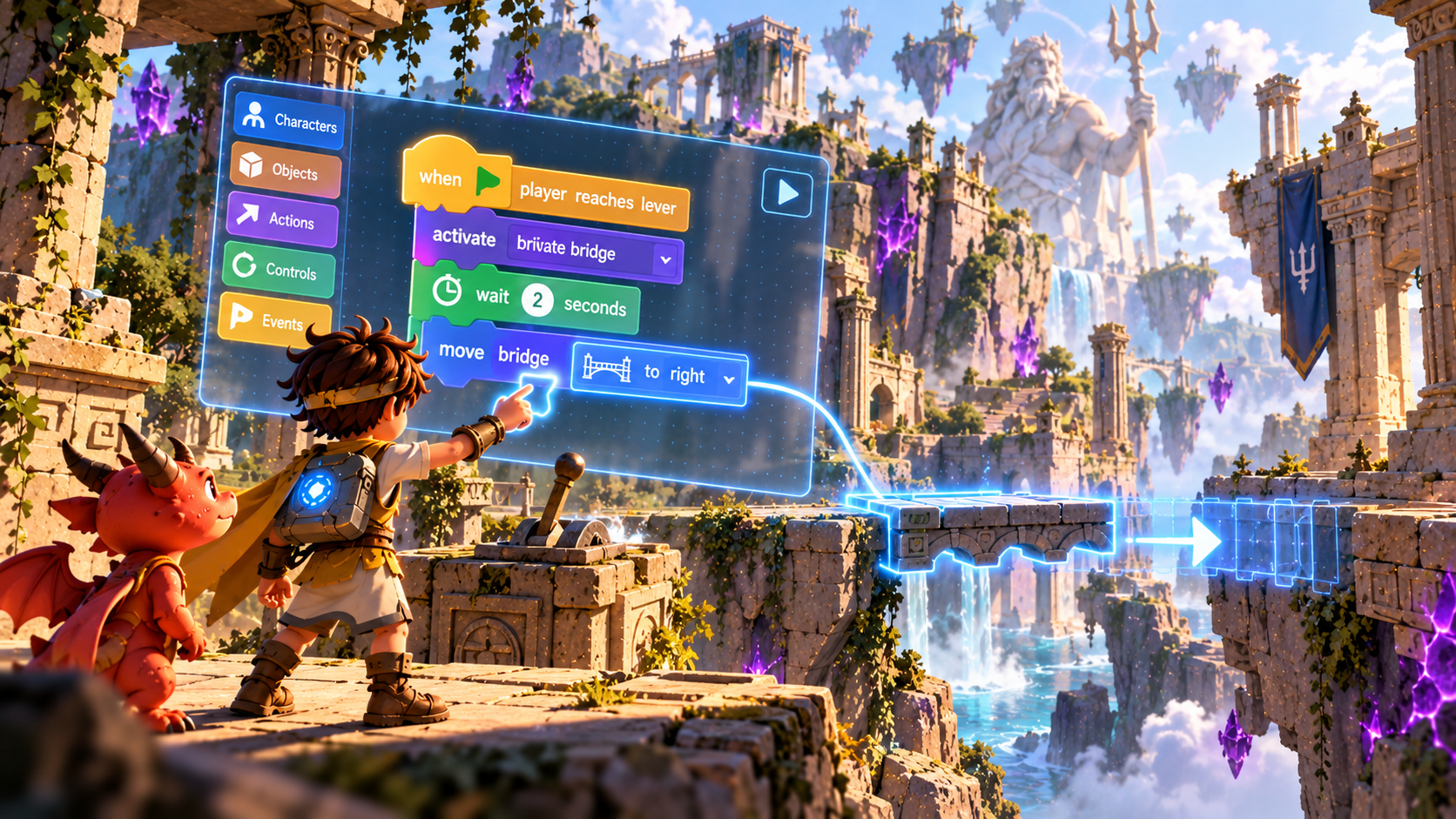
VISUAL SCRIPTING
MAKE PROGRAMMING THE CORE GAMEPLAY MECHANIC.
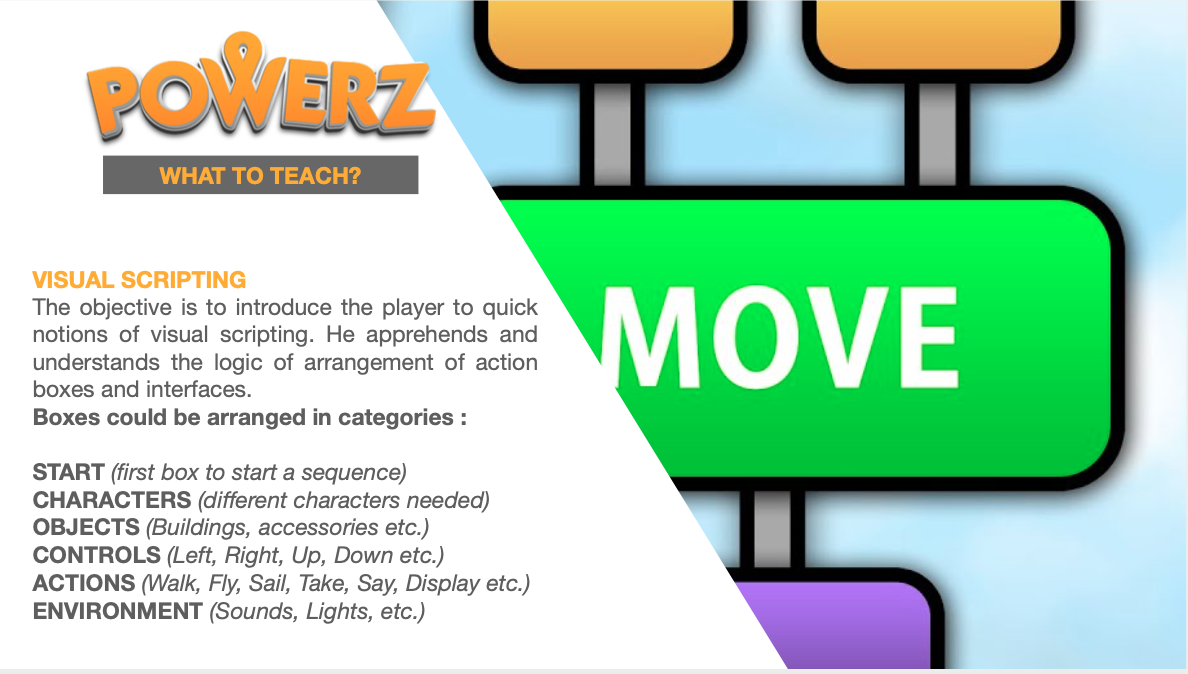
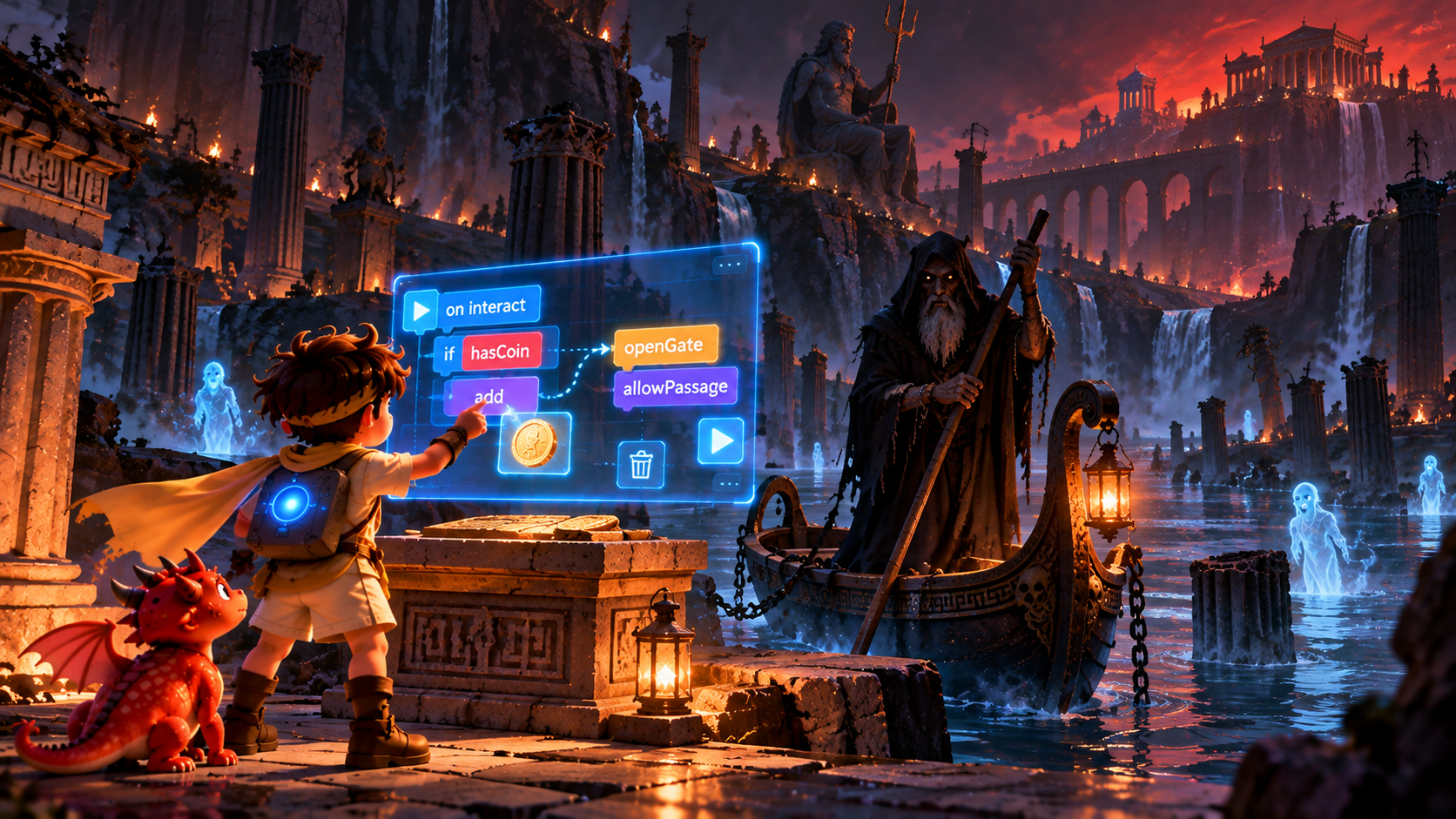
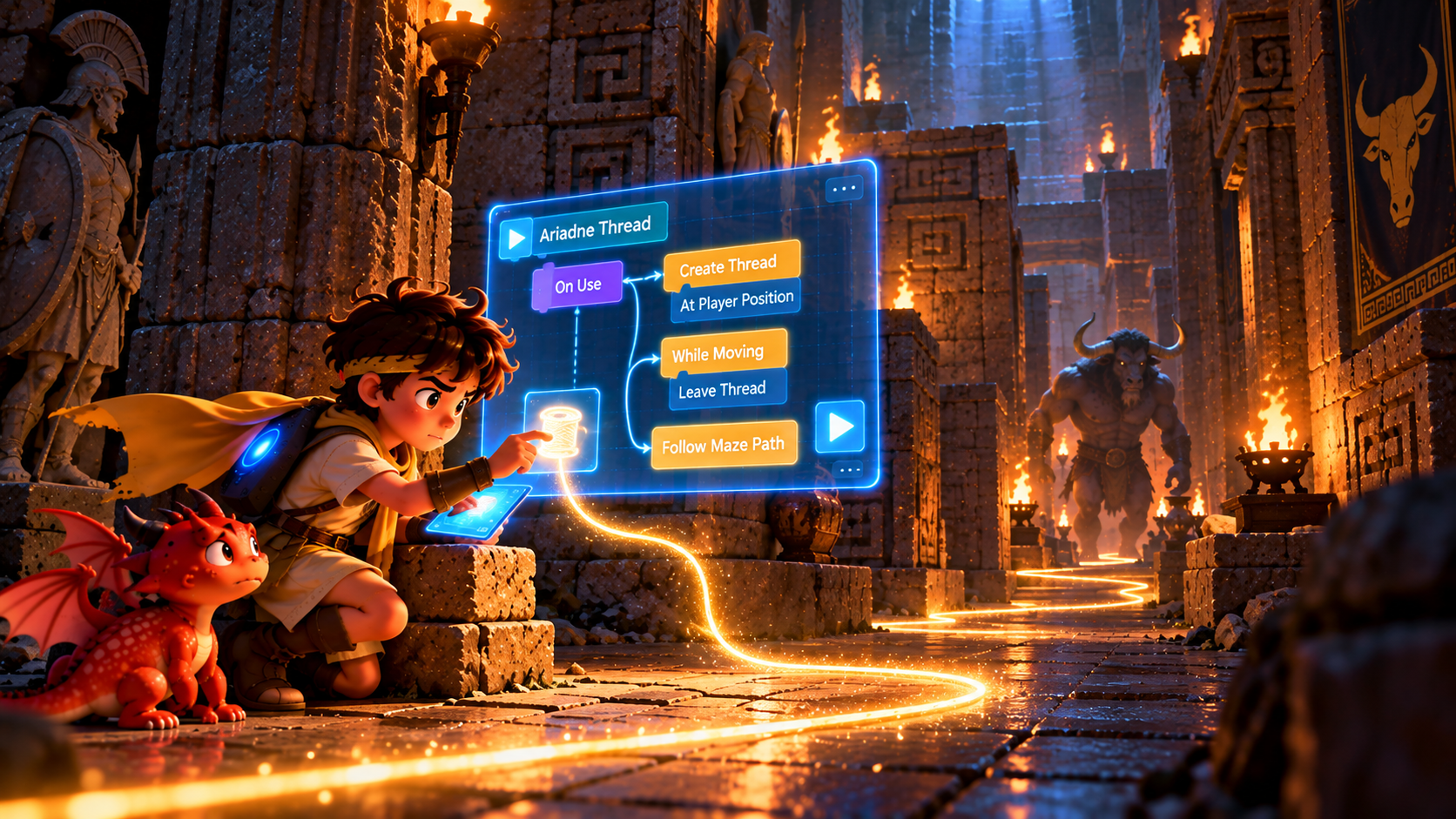
Players use an intuitive visual scripting tool to build sequences of commands and interact with the world. By combining blocks representing characters, objects, actions, controls and environmental elements, they can program behaviors and trigger events.
The system introduces fundamental programming concepts through experimentation, encouraging players to understand how individual instructions work together to produce a desired result.
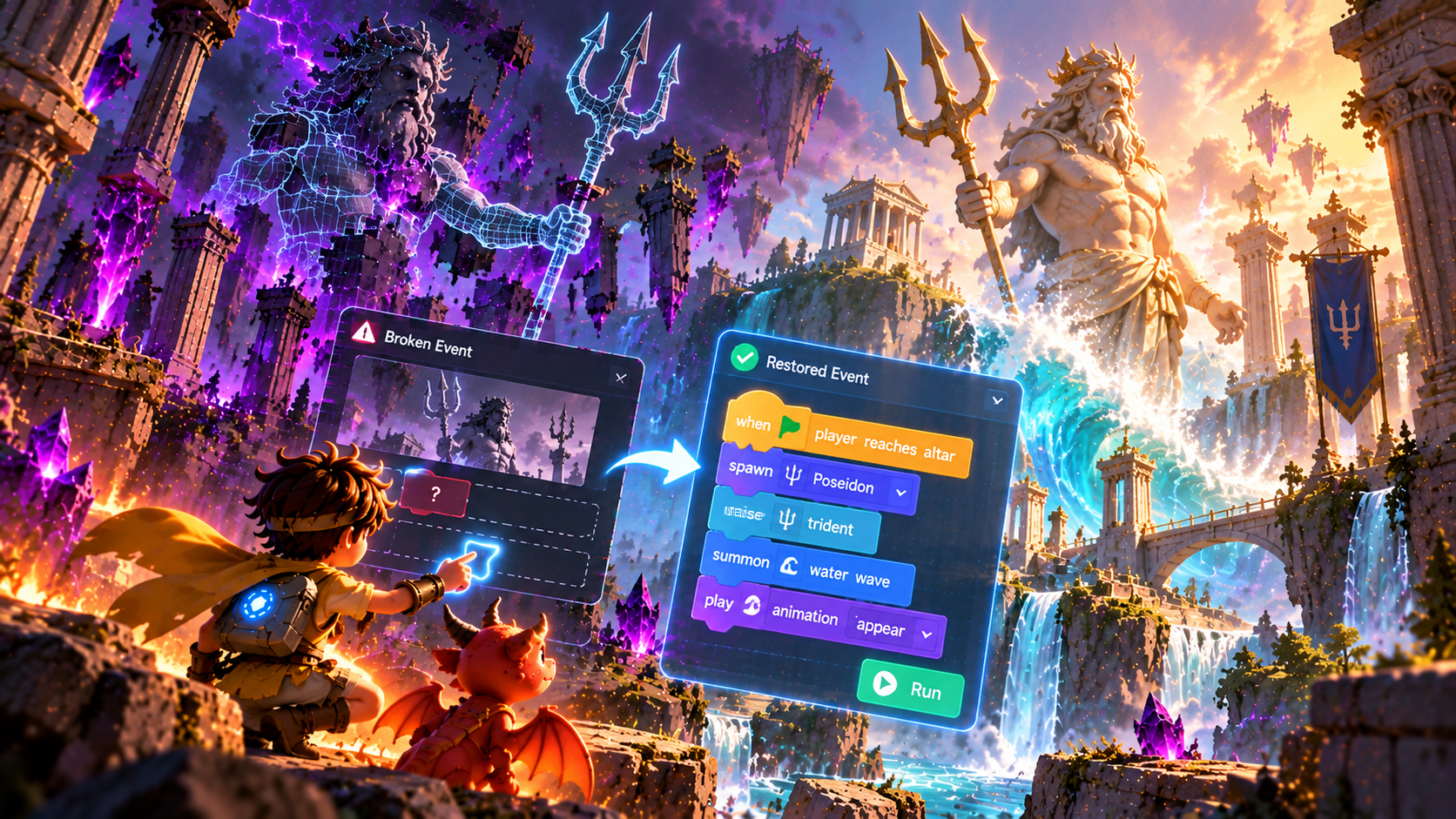
MYTHOLOGICAL DEBUGGING
FIX THE CODE. REWRITE THE LEGEND.
Iconic scenes from Greek mythology have been corrupted by Amnesium, leaving characters, objects and behaviors missing or malfunctioning.
Players investigate these anomalies and reconstruct the events through visual scripting. Once the correct sequence has been assembled, they can execute it and restore the mythological scene, turning each puzzle into an interactive storytelling experience.
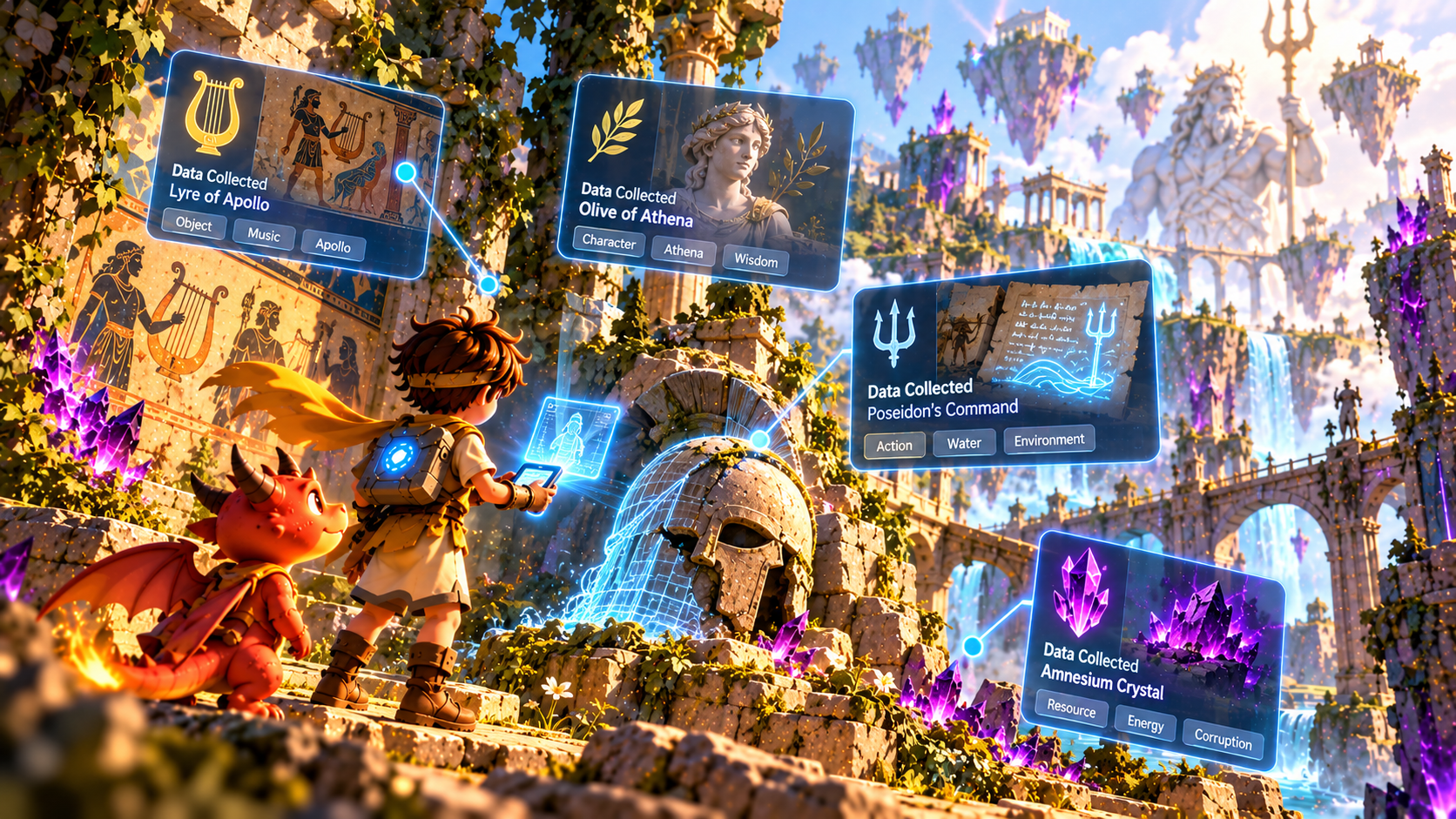
DATA COLLECTION
EXPLORE TO UNDERSTAND. DISCOVER TO PROGRESS.
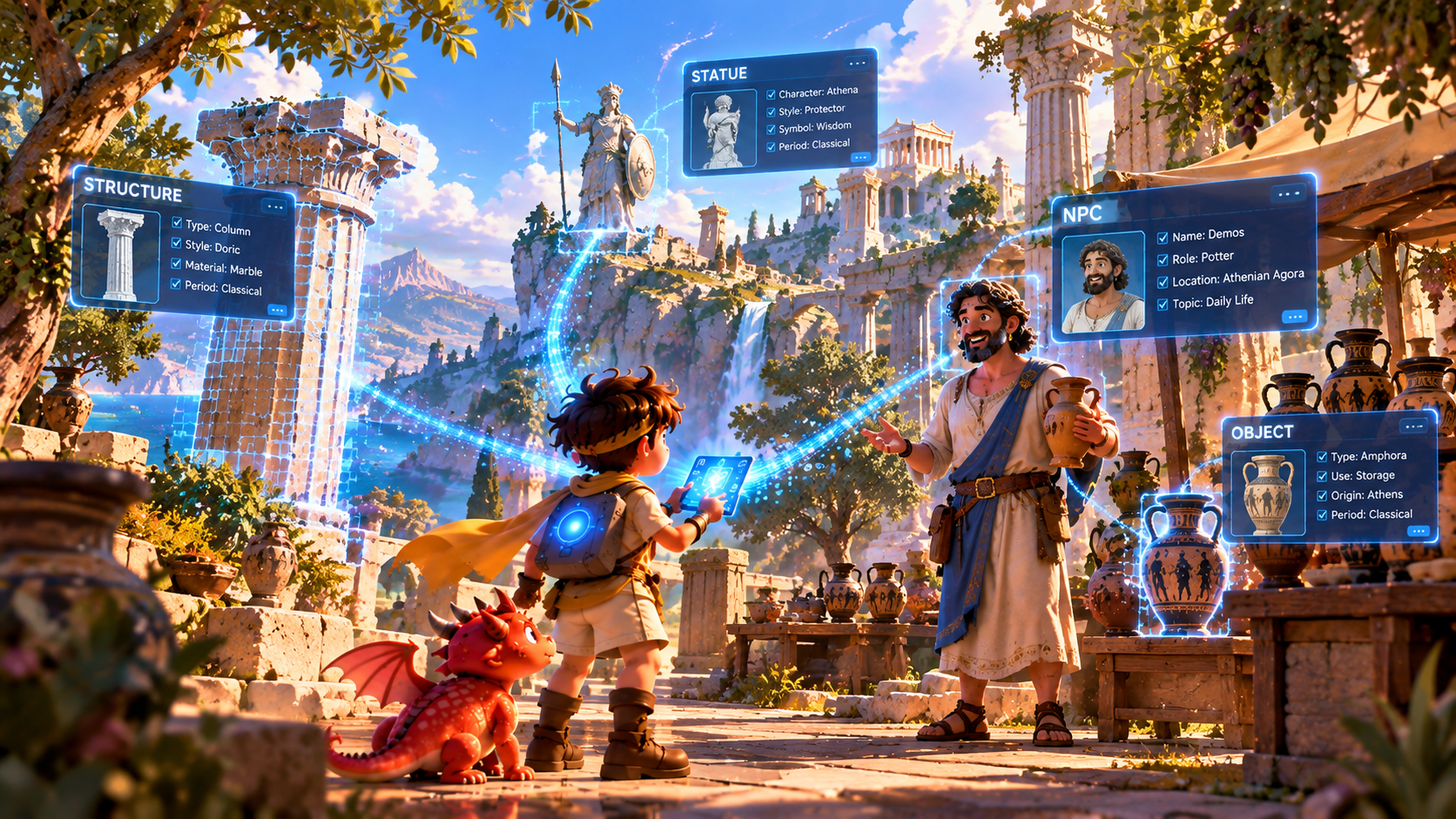
Exploration provides the knowledge required to solve programming challenges. By investigating environments, interacting with mythological characters and discovering lore, players collect the data needed to complete their scripting sequences.
This creates a direct connection between world exploration and puzzle-solving, rewarding curiosity while making Greek mythology an essential part of gameplay progression.
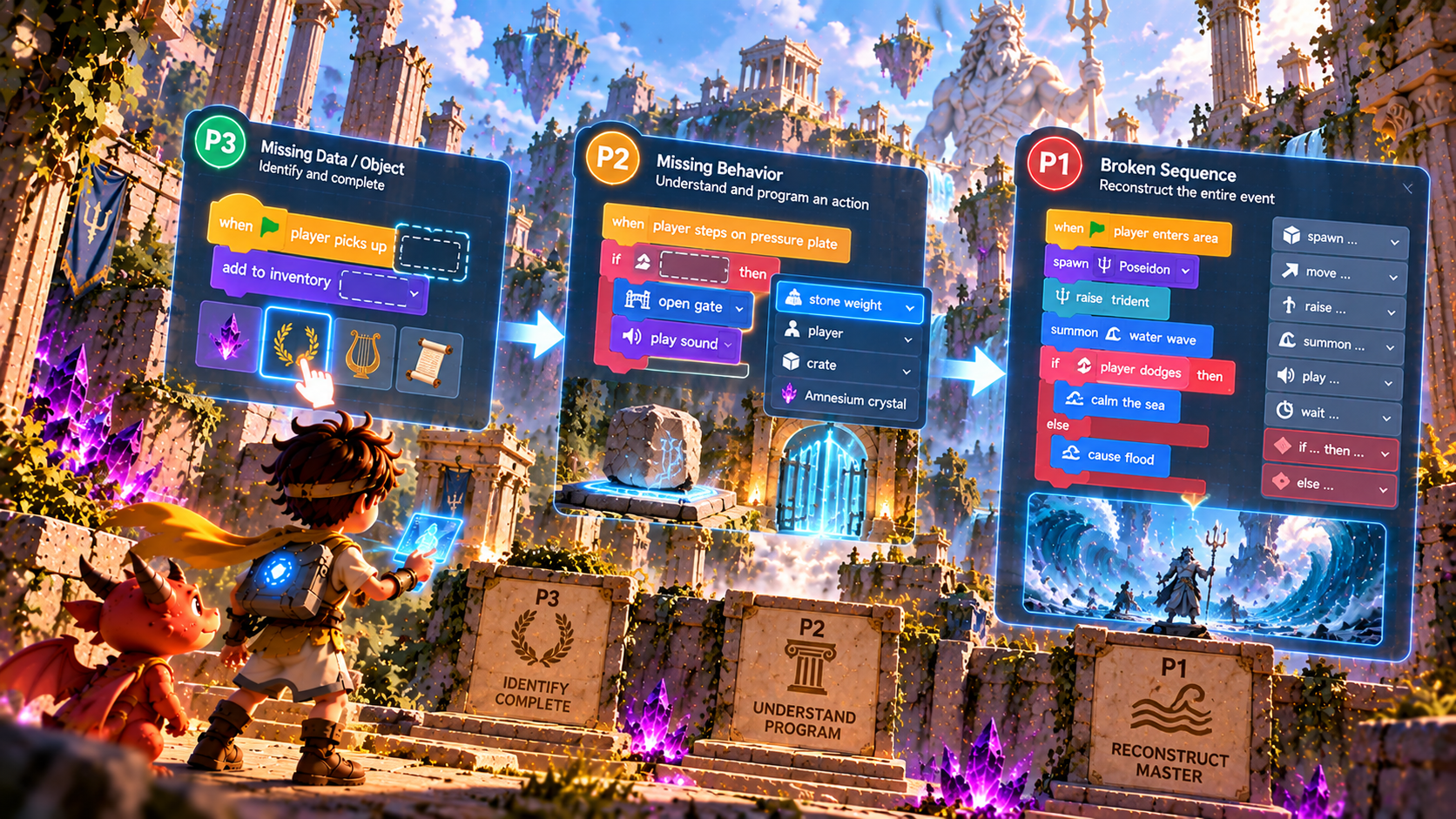
PROGRESSIVE DEBUGGING CHALLENGES
FROM MISSING DATA TO COMPLETE RECONSTRUCTION.
Programming challenges are structured around three levels of complexity. Early puzzles require players to identify and replace missing information, while more advanced situations involve reconstructing character behaviors and interactions.
The most complex challenges present entirely broken sequences, requiring players to determine which characters, objects and actions are needed.
04
BOSS ENCOUNTERS
Boss encounters transform traditional combat into interactive programming puzzles. Rather than relying on direct attacks, players must observe enemy patterns, repair corrupted environments and use visual scripting to create strategic opportunities.
Each encounter introduces timing, anticipation and problem-solving, challenging players to apply their programming knowledge under increasingly demanding conditions.
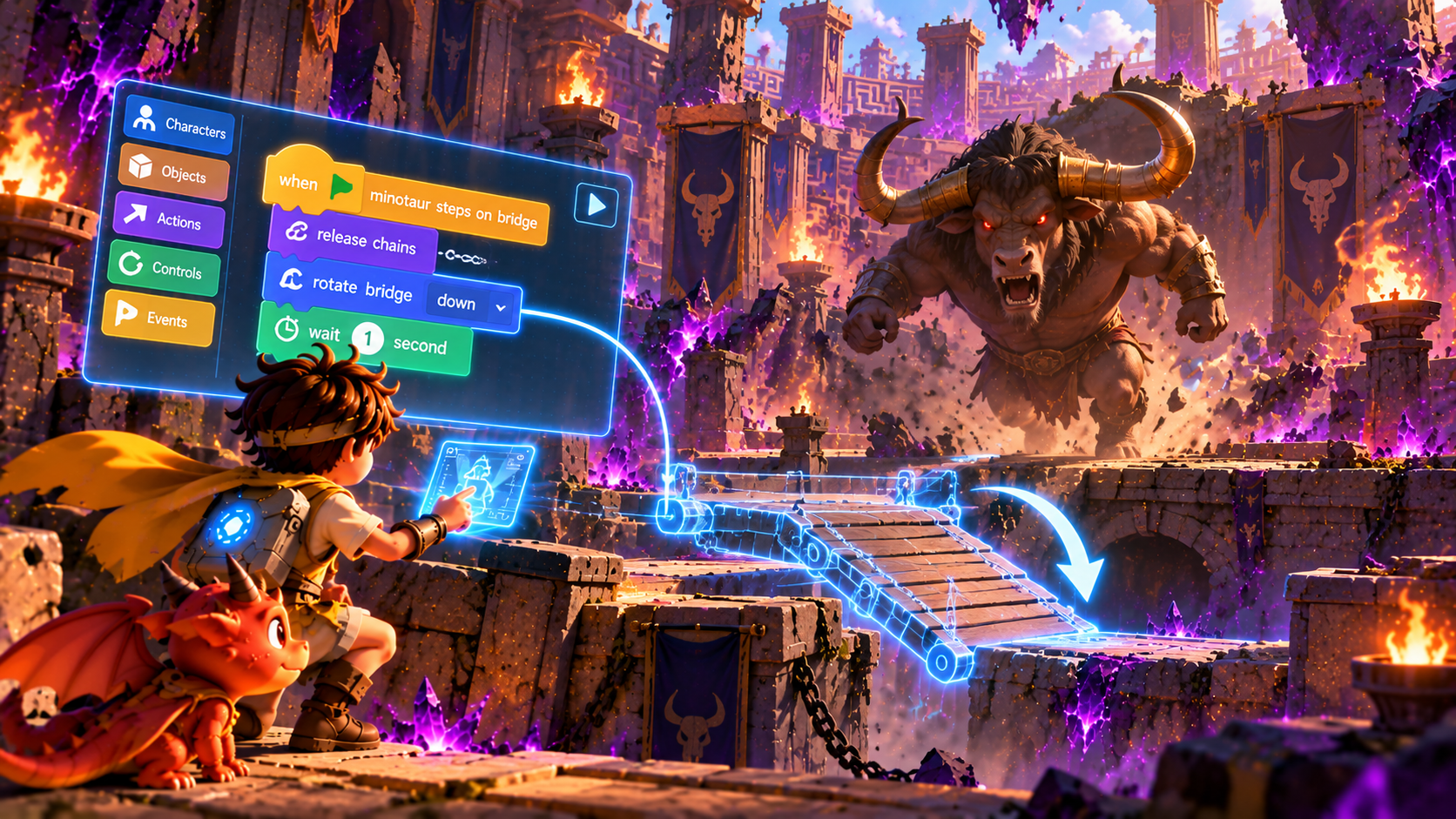
THE MINOTAUR
LANDS · MINI-BOSS · BUG P3
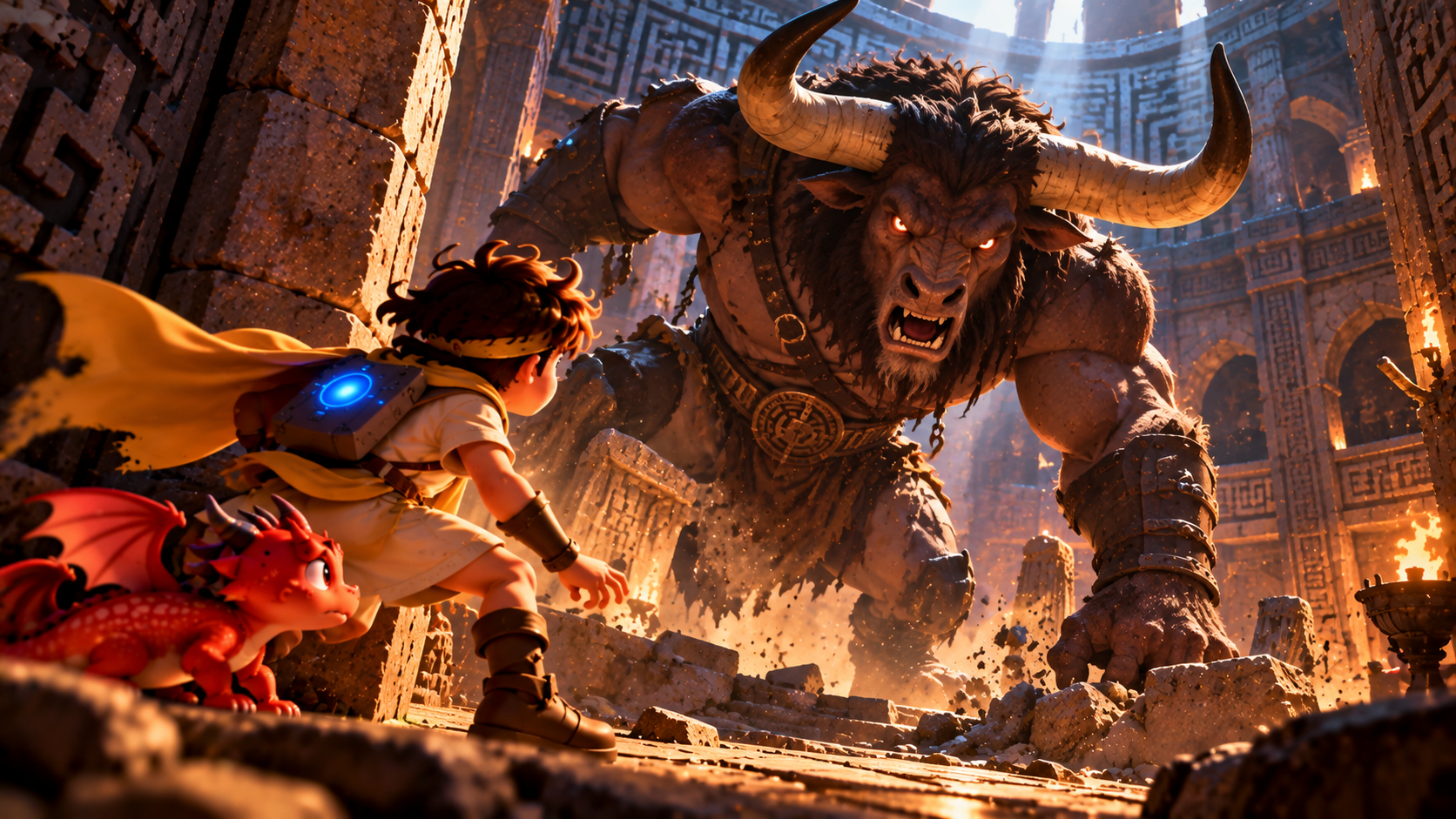
The Minotaur relentlessly pursues the player through an arena corrupted by Amnesium. By studying its movement pattern, players must identify safe opportunities to repair the environment and program traps.
This first encounter introduces timing and strategic thinking while applying the simplest level of debugging challenges to a dynamic situation.
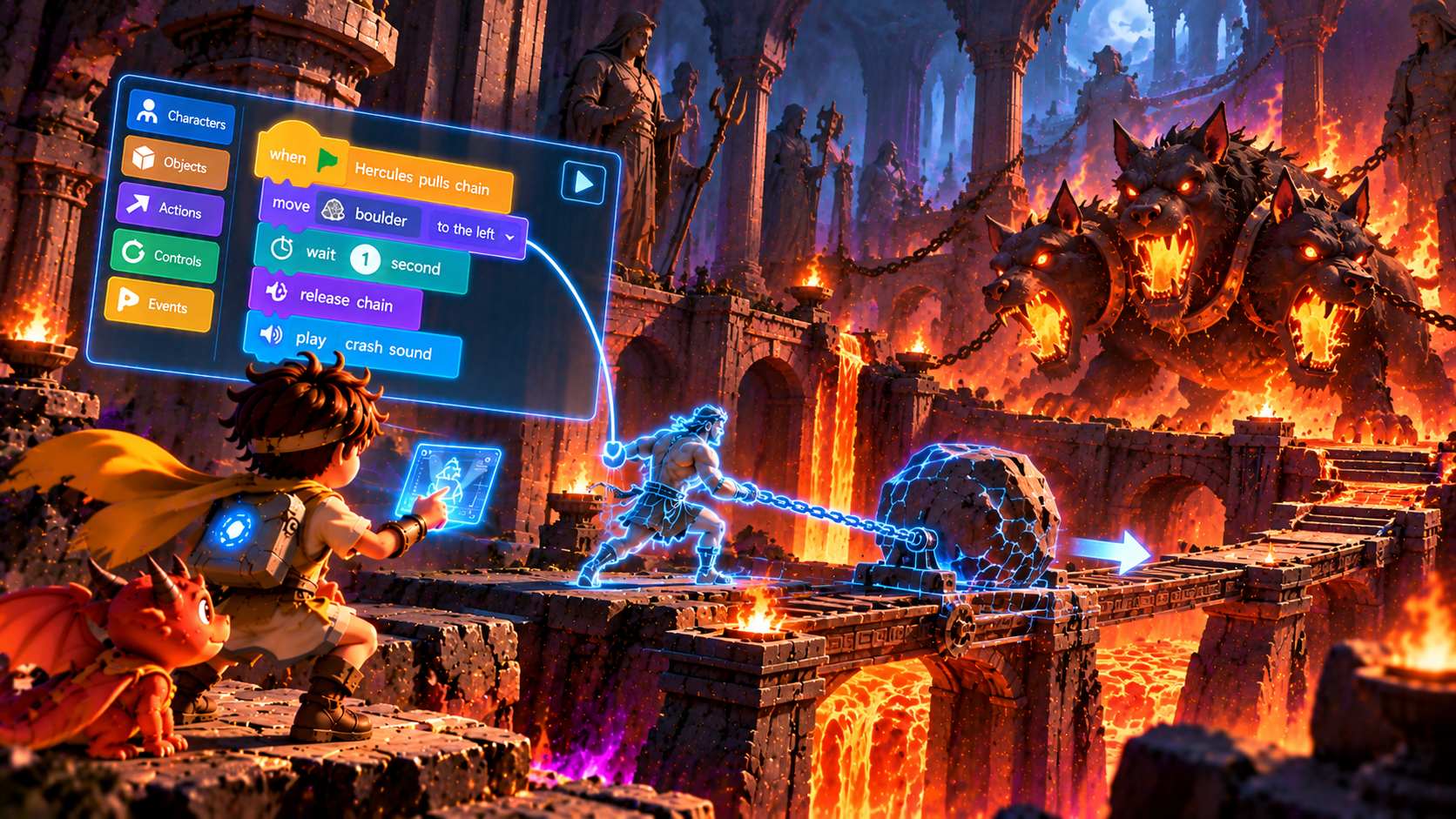
CERBERUS
UNDERWORLD · MINI-BOSS · BUG P2
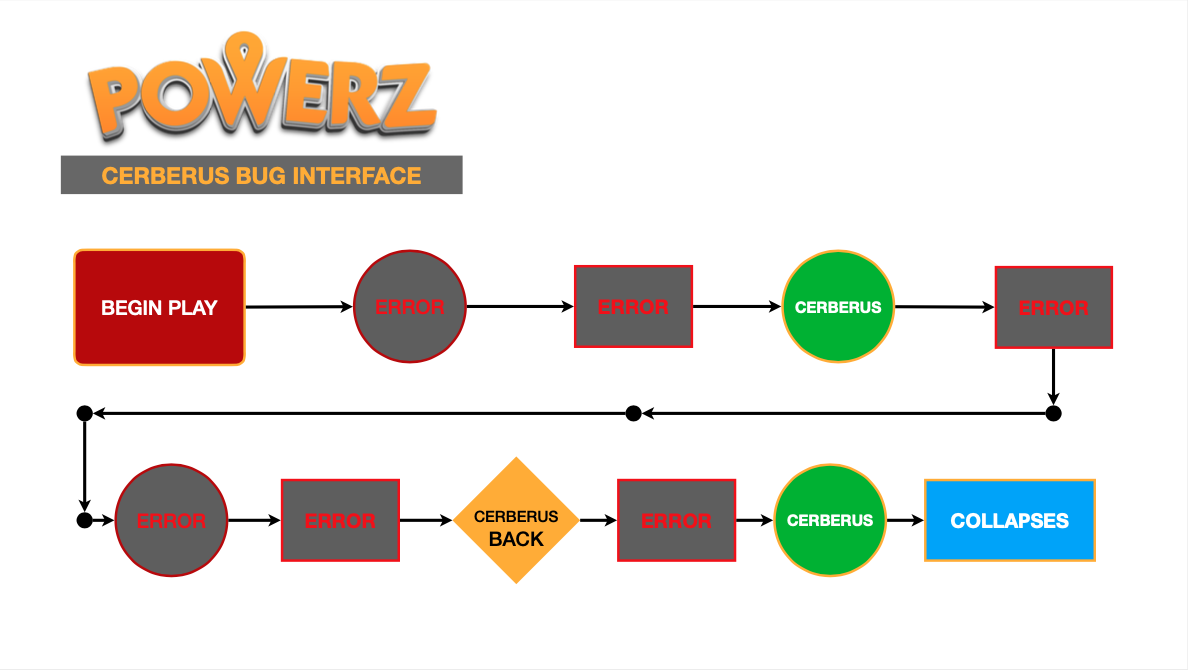
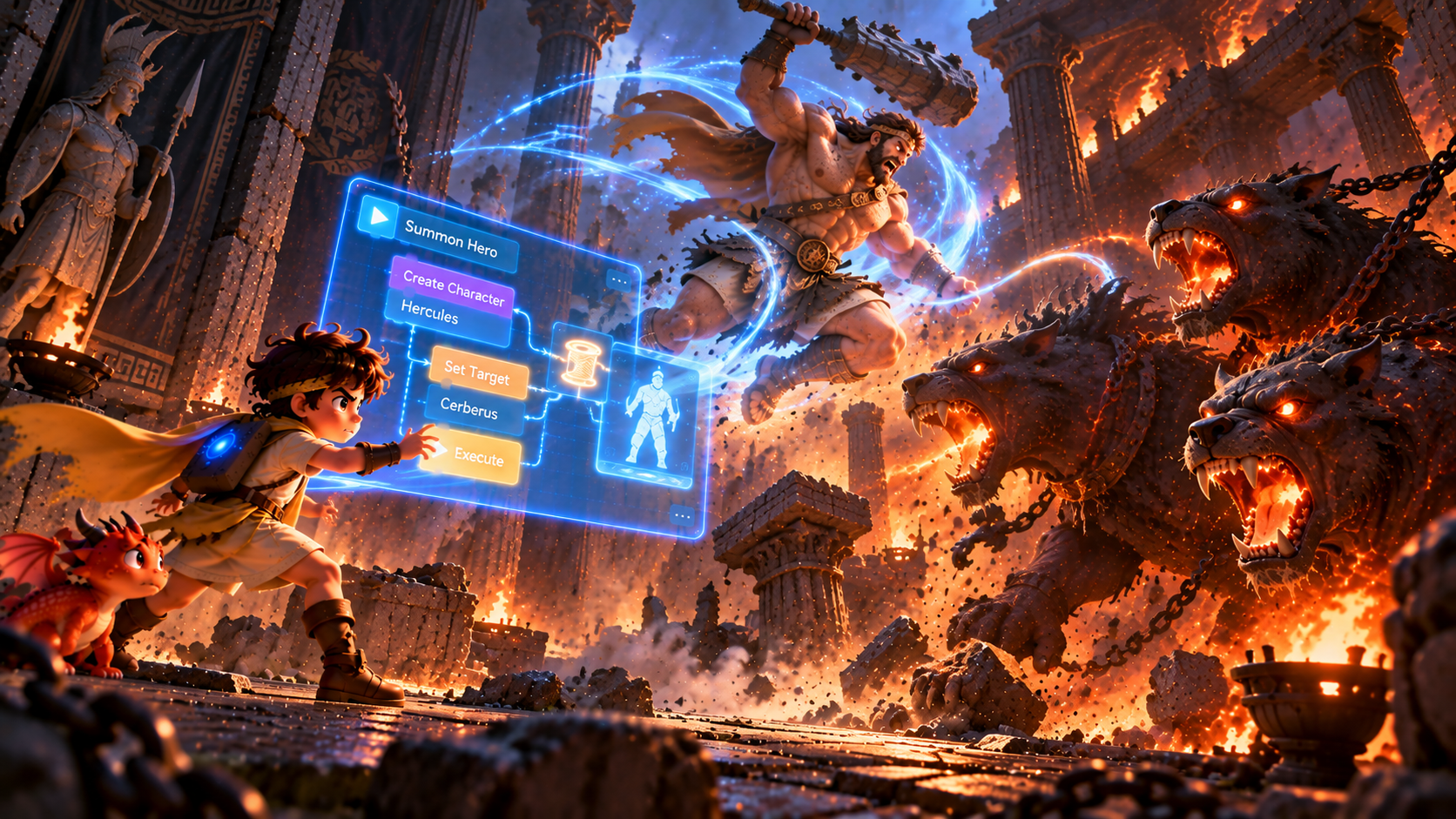
Facing Cerberus requires more than repairing the arena. Players must observe the creature’s behavior, restore safe areas and use visual scripting to program Hercules’ actions.
Building on the previous encounter, this challenge introduces more complex behavioral programming, combining environmental problem-solving with the timing needed to overcome the guardian of the Underworld.
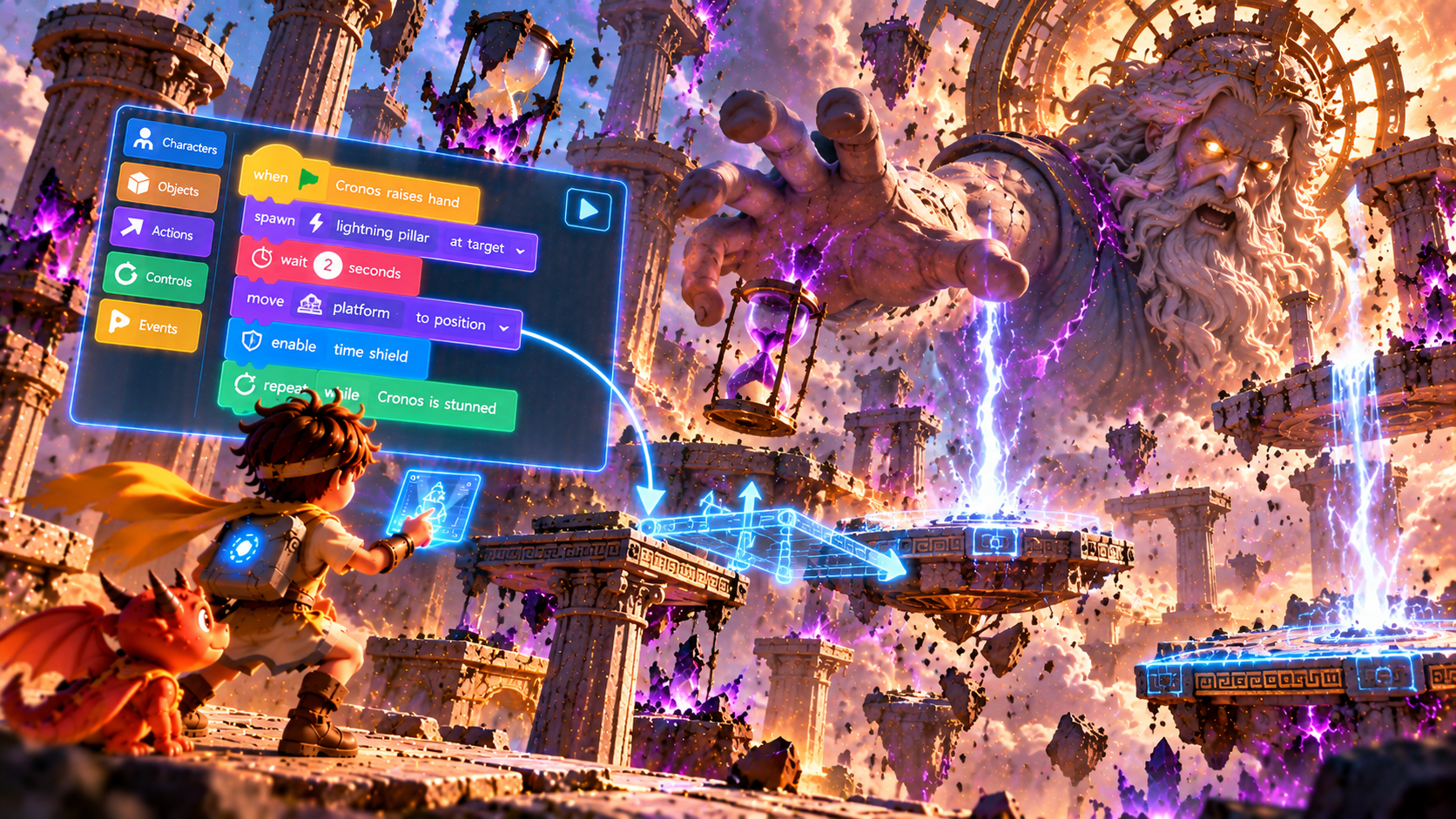
CRONOS
MOUNT OLYMPUS · FINAL BOSS · BUG P1
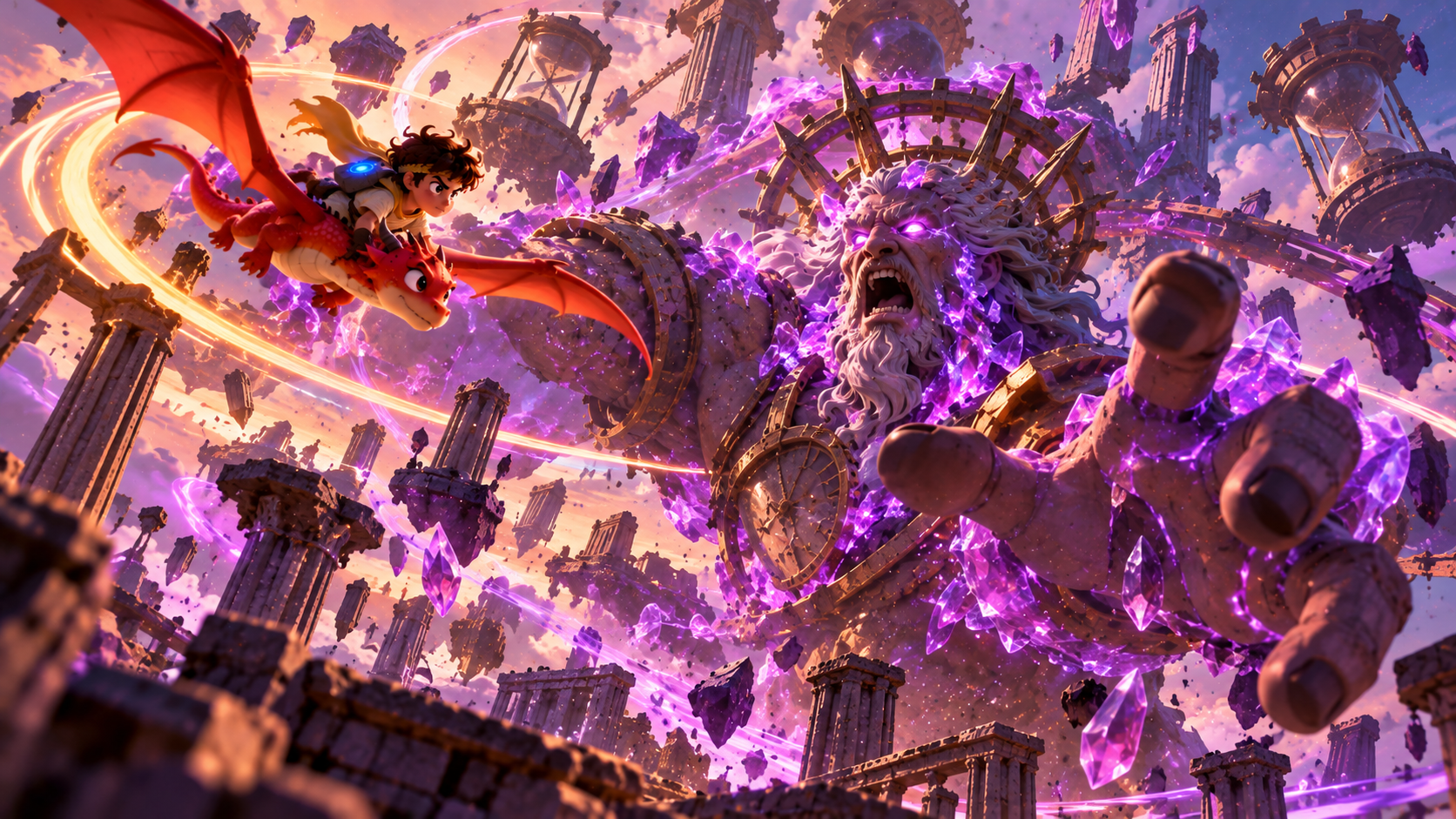
The final encounter brings together the full range of programming mechanics. As Cronos pursues the player through a heavily corrupted arena, players must anticipate his attack pattern, restore safe areas and program objects and traps.
Victory ultimately depends on reconstructing Zeus’ behavior through visual scripting, transforming the confrontation into a comprehensive test of everything learned throughout the adventure.
05
MISSIONS &
RESPONSIBILITIES
Working independently on a recruitment design test, I developed a comprehensive Game & Level Design proposal built around two educational objectives: introducing children to programming and Greek mythology.
My responsibilities covered the entire conceptual design process, from defining the core mechanics and learning progression to structuring the world, designing encounters and documenting the experience in a detailed Game Design Document.
- Designed a visual scripting system as the central gameplay mechanic, defining command categories, player interactions and debugging challenges. Developed variations of the system for exploration, environmental puzzles and boss encounters.
- Structured an adventure across three mythological regions, defining their environments, progression objectives, exploration opportunities and boss encounters. Designed level maps and progression rules connecting the different areas.
- Integrated programming fundamentals and Greek mythology into the core gameplay loop. Structured debugging challenges around three complexity levels, progressively increasing the player’s autonomy and understanding of programming logic.
- Designed three puzzle-driven boss encounters featuring the Minotaur, Cerberus and Cronos. Adapted visual scripting mechanics to combat situations through enemy patterns, environmental manipulation, timing and strategic problem-solving.
- Developed a narrative framework connecting Amnesium’s corruption to the disappearance of mythological knowledge. Designed exploration objectives and interactive challenges around the restoration of legendary events.
- Produced a comprehensive 112-page Game Design Document detailing the gameplay systems, educational approach, world structure, level maps, encounter mechanics and narrative intentions.
06
FROM CONCEPT TO
DESIGN DOCUMENTATION
This 25-pages Game Design Document brings together the systems, environments and encounters developed for my POWERZ recruitment design test.
Beyond the creative concept, the document details how educational objectives translate into gameplay mechanics, how challenges evolve in complexity and how world progression, storytelling and boss encounters work together to create a cohesive experience.
01
CORE GAMEPLAY SYSTEM
VISUAL SCRIPTING FRAMEWORK
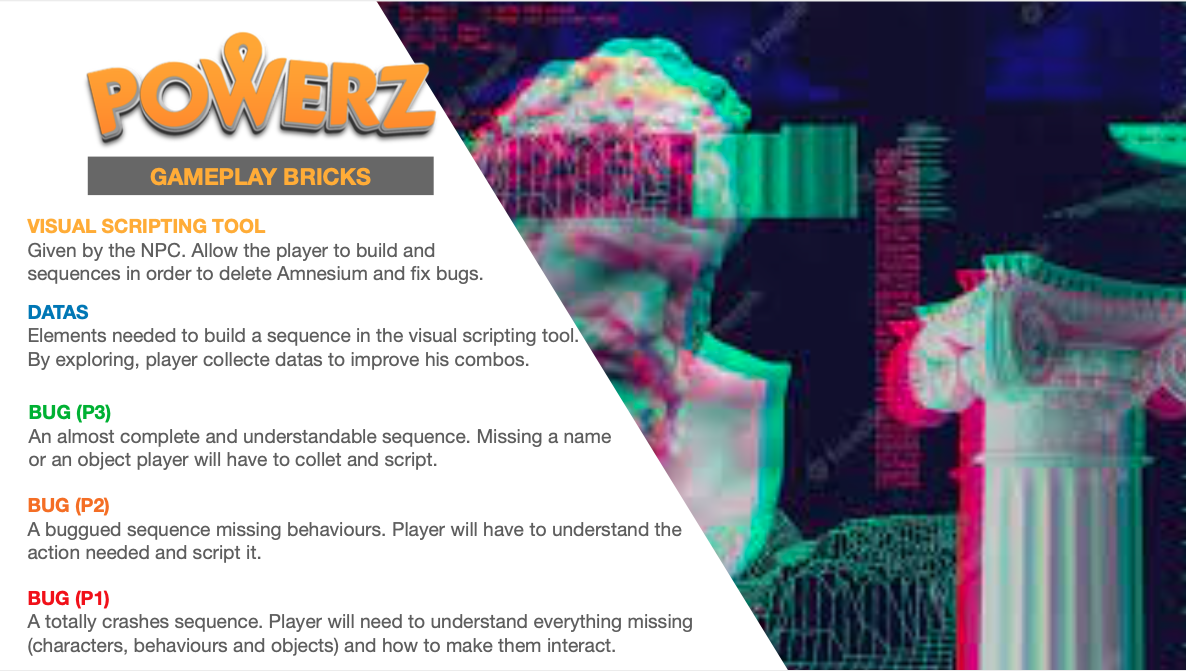
A comprehensive breakdown of the visual programming system designed to make coding accessible, intuitive and engaging for younger players. The documentation details the different command categories, their interactions and the underlying logic used to build and execute programming sequences.
Through a block-based interface, players can combine instructions to control characters, manipulate objects, modify environmental elements and trigger specific behaviors. Each interaction encourages experimentation and helps players understand the relationship between commands, conditions and their resulting actions.
The system was designed to support a progressive learning curve, introducing fundamental programming concepts through increasingly complex challenges. By integrating visual scripting directly into exploration, puzzle-solving and encounters, programming becomes more than an educational feature: it becomes the primary tool through which players interact with and restore the mythological world.
02
WORLD STRUCTURE & LEVEL MAPS
DESIGNING MYTHOLOGICAL PROGRESSION
A comprehensive overview of the world and level design structure, built around three distinct regions inspired by Greek mythology: The Lands, The Underworld and Mount Olympus. Each region features its own environments, legendary encounters, exploration opportunities and narrative challenges, contributing to a cohesive and interconnected adventure.
The documentation presents the level maps, key landmarks and progression rules that guide players through the mythological world. Exploration is structured around the discovery of forgotten knowledge, the restoration of corrupted events and the completion of programming challenges, progressively opening access to new locations.
Particular attention was given to connecting educational progression with environmental discovery. By completing objectives, overcoming mythological encounters and recovering essential information, players gradually unlock the path toward Mount Olympus.
This approach ensures that level progression is not simply a sequence of destinations, but a meaningful journey in which exploration, storytelling and gameplay mechanics continuously reinforce one another.
03
CHALLENGE PROGRESSION
STRUCTURING THE LEARNING CURVE
A progressive challenge system designed to introduce programming concepts through increasingly complex debugging situations. The documentation establishes three distinct difficulty levels — BUG P3, BUG P2 and BUG P1 — each requiring players to develop new problem-solving skills and apply their knowledge with greater autonomy.
The first challenges focus on identifying missing information within partially functional sequences. As players progress, they encounter more complex situations involving corrupted behaviors, incomplete interactions and programming errors that require a deeper understanding of the visual scripting system.
At the highest level of complexity, players must reconstruct entirely broken sequences, identifying the necessary characters, objects and actions before assembling the commands required to restore a mythological event.
This progression was designed to encourage experimentation, logical reasoning and independent problem-solving while maintaining a clear connection between educational objectives and gameplay.
By gradually increasing the complexity of each challenge, the system transforms debugging into a rewarding learning experience, allowing players to develop confidence in their programming abilities while overcoming increasingly demanding obstacles.
04
BOSS ENCOUNTER DESIGN
TURNING MYTHOLOGY INTO GAMEPLAY CHALLENGES
A detailed exploration of three major boss encounters inspired by Greek mythology: the Minotaur, Cerberus and Cronos. Each confrontation was designed as a unique gameplay challenge, combining mythological storytelling, environmental interactions and the visual programming mechanics established throughout the adventure.
The documentation outlines the structure of each encounter, including its objectives, gameplay phases, progression conditions and the specific programming challenges players must overcome. Rather than relying on traditional combat mechanics, these encounters encourage players to observe their surroundings, identify problems and construct logical solutions using the tools they have progressively mastered.
Each boss introduces a different approach to problem-solving, requiring players to adapt their strategies and apply previously acquired knowledge in increasingly demanding situations. Environmental elements, character behaviors and scripted events become essential components of the encounter design, reinforcing the connection between programming and meaningful gameplay consequences.
Particular attention was given to the pacing and escalation of these confrontations. Each encounter serves as a milestone in the player’s educational journey, testing their understanding of core mechanics while delivering a memorable narrative moment.
By transforming legendary mythological figures into interactive programming challenges, the proposed boss designs aim to demonstrate how educational objectives can support engaging encounters without sacrificing accessibility, player agency or the sense of accomplishment.
07
CONCEPT ARTS
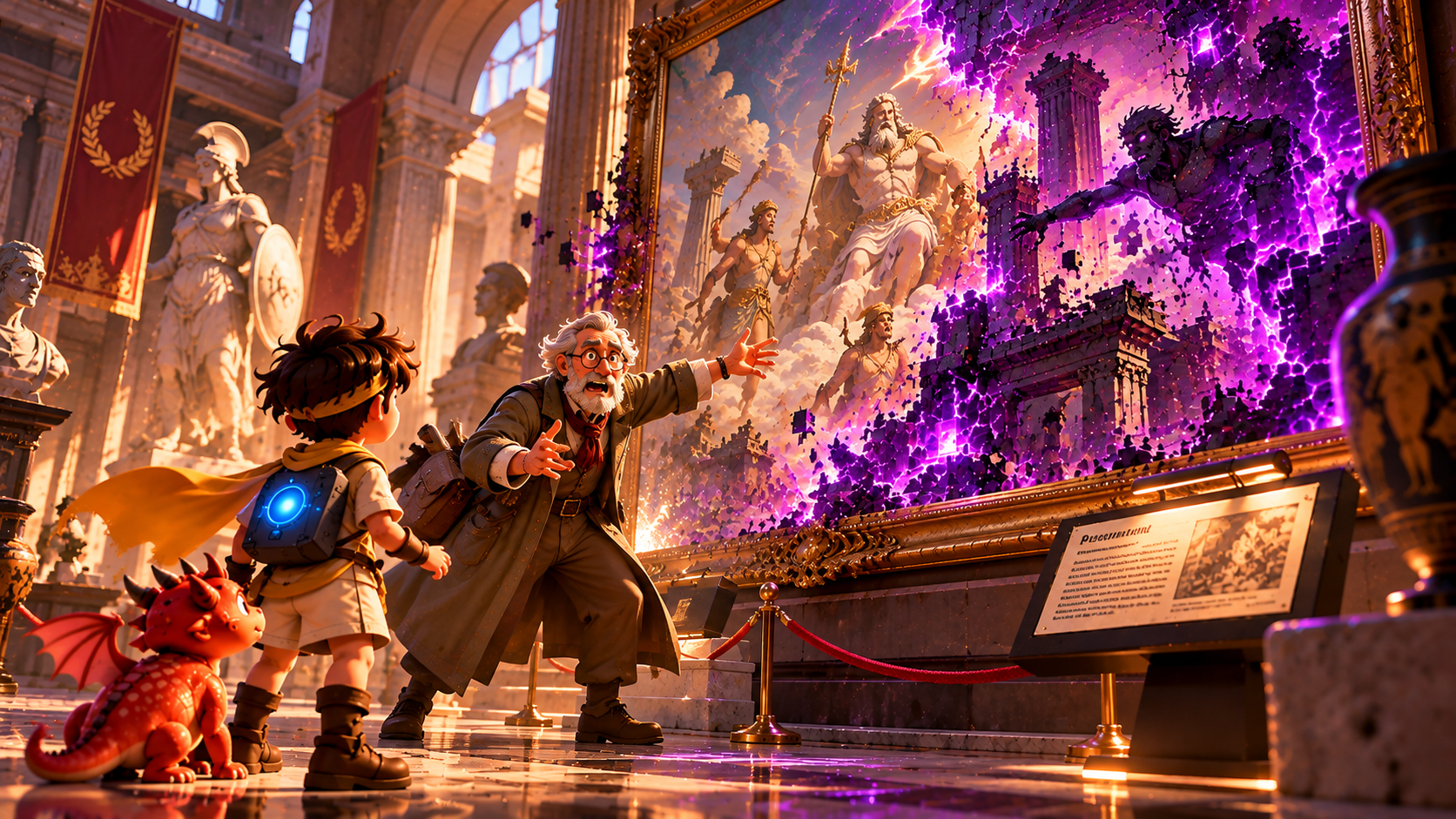
Created to complement my Game Design Document, these visuals help communicate the intended tone and visual identity of the experience, where curiosity, discovery and programming-driven challenges come together in a vibrant mythological adventure.
Select an image to enlarge it.
08
WHERE MYTHOLOGY MEETS LOGIC.
From corrupted legends to programmable encounters, POWERZ reflects my approach to Game Design: connecting mechanics, storytelling and player progression to create meaningful experiences.